


Altri articoli della stanza Economia
Tackling Climate Change: THE WAY FORWARD TO COPENHAGEN
The IV ASSESSMENT REPORT ON CLIMATE CHANGE
According to the 2007 Report of the Intergovernmental Panel on Climate Change (IPCC), some extreme weather events will become more frequent, more widespread and/or more intense during the 21st century.
Climate change presents a serious threat to security and prosperity because of the destabilizing effects of storms, drought, and floods.
A global CO2 emissions reduction by 30%-50% should be reached in the timeframe 2030-2050 to drive the stabilization of CO2 concentration to a safe level (450-550 PPMv) by the end of the century and avoid irreversible changes in the climate system.
A CONFLICT OF INTEREST ENERGY SECURITY AND CLIMATE SECURITY
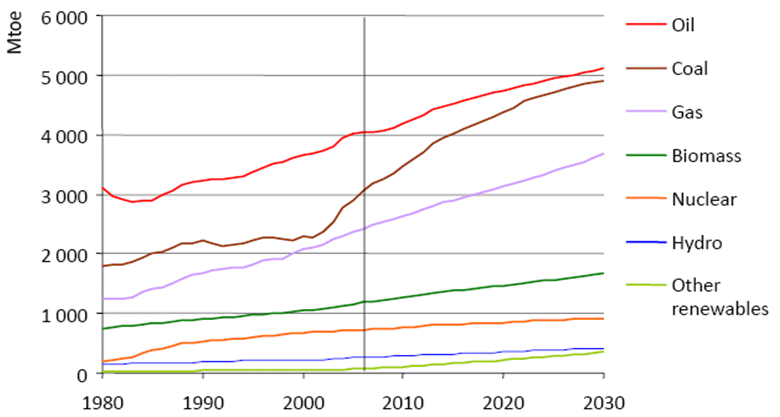
According to the WEO 2008 Reference Scenario, global primary energy demand will grow by 1.6% per year on average in 2006-2030, from 11,730 Mtoe to just over 17,010 Mtoe, with fossil fuels accounting for 80% of the world’s primary energy mix in 2030.
According to the IEA’s “Energy Technology Perspectives 2008 – ETP,” primary energy demand will continue to rise to 2050, reaching 23,268 Mtoe.
Due to strong economic growth, slowed but not stopped by the current financial and economical crisis, China and India account for 51% of incremental world primary energy demand in 2006-2030, while non-OECD countries account for 87% of the increase in global energy demand, with their share of world primary energy demand rising from 51% to 62%.
World primary energy supply
2030 World primary energy demand – Source: IEA, WEO 2008
Energy-Related CO2 emissions by Region
Non-OECD countries account for some 97% of CO2 emissions increase between now and 2030 - three-quarters from China, India & the Middle East alone.
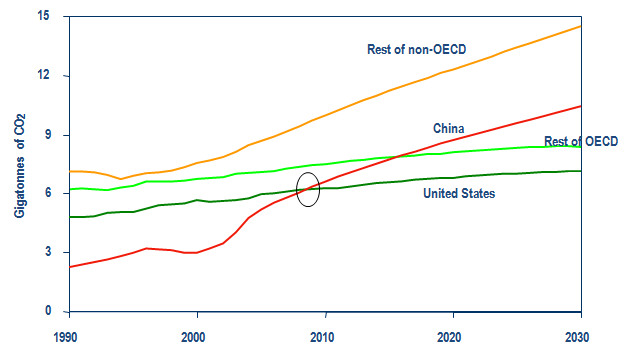
Source: WEO 2006, International Energy Agency
CO2 per capita emissions 1980-2030

CO2 energy-related emissions will increase by 45% in 2030 and, according to IEA ETP 2008, by 130% in 2050 .

CUMULATIVE INVESTMENT, 2005-2030
$26 trillion
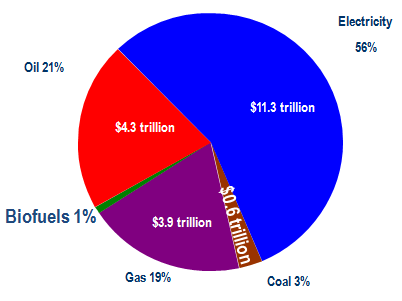
CUMULATIVE INVESTMENT, 2005-2050
demand-side and supply-side: over USD 250 trillion

STABILIZING CO2 TECHNOLOGY DEVELOPMENT, EQUITABLE GLOBAL BURDEN SHARING,AND FAIR COMPETITION IN THE GLOBAL ENERGY MARKET
Stabilizing CO2 requires a global long term strategy (2050 at least) in:
-
research & innovation and energy policies to reduce the “carbon intensity” of the economy through the development and dissemination of new renewable and energy efficiency technologies, biofuels, hydrogen, carbon sequestration, and nuclear power
-
making the new clean and safe energy sources and technologies available and cost-effective in the emerging economies and in the developing world to address both energy security and emissions reduction
To be effective in approaching CO2 stabilization, the measures should be designed and implemented immediately.
Considering the lifetime of power plants and industrial processes (20 to 50 years), and taking into account the IEA-estimated dimension of the investments in the global energy system in the next 30-50 years ($26 to 250 trillion), the countries in the Climate Change Convention and in the World Trade Organization should consider:
-
an equitable global burden sharing of the reduction based on per capita emissions/GDP
-
the introduction of rules in the global energy market for the application of progressive “carbon intensity standard” for the energy technologies
-
a progressive “carbon price” to be applied to fuels and technologies
TECHNOLOGY DEVELOPMENT IN BLUE MAP SCENARIO IEA ETP 2008
identifies the technology options to meet 50% emissions reduction in 2050, according to the 2008 G8 Summit Declaration, consistent with the 450 PPM CO2 stabilization stabilisation scenario.

ADDITIONAL INVESTMENT IN BLUE MAP SCENARIO
An additional 45 trillion USD are required for meeting the BLUE Map scenario to cover:
-
additional R&D investments in new technologies not yet market-competitive
-
larger deployment and commercial investment in low-carbon options
-
global dissemination of cleaner and more energy efficient technologies
In BLUE Map, the marginal costs are negative for the end-use efficiency technologies, and up to 200 USD per ton of CO2 are saved (500 USD as pessimistic forecast) for the development and deployment of the new technologies in the power sector and transportation, including higher-cost options such as CCS in industry and alternative transport fuels.
MARGINAL COSTS IN BLUE MAP: THE CHALLENGE OF ADAPTATION
Climate change can act as a threat multiplier for instability in some of the most volatile and poor regions of the world.

Africa and parts of Asia are particularly vulnerable given their locations and their limited governmental capacities to respond to flooding, droughts, and declining food production.
Like armed attacks, some of the effects of climate change could swiftly kill or endanger a large number of people and cause such large-scale disruption that local public health, law enforcement, and emergency response units would not be able to contain.
The Stern Review estimated that it would cost developing countries between $4 billion and $37 billion/year to minimize the climate change damage.
The Global Environment Facility (GEF) adaptation funds amount to about $215 million: their scale should be dramatically expanded.
A modest investment in adaptation in poor countries will be much more effective than responding to state failure or humanitarian disasters through military and relief operations.
EU and USA
A New Joint Commitment
The negotiations for an agreement in Copenhagen are difficult because of the multiple issues involved and because of the different historical approaches between the Parties involved.
EU and USA could and should change the international context of the negotiations, building a bilateral concrete platform for the development of:
-
common standards in the energy and transportation technologies to move towards a low carbon economy
-
joint measures to incentivize clean energy and transportation technologies
-
joint partnerships with Brazil, China, India, Mexico, South Africa for the deployment and the dissemination of low carbon technologies in the emerging economies
-
joint projects to support the least developed countries with their adaptation to the effects of climate change
Corrado Clini
Director General Ministry for the Environment, Land and Sea of Italy