Altre stanze in Politiche Energetiche
Altri articoli della stanza Politiche Energetiche
Turkey as an energy bridge between East and West - Tolga Turan -
The idea of an east-west energy corridor has emerged as soon as the Soviet Union collapsed and the energy rich countries in the Caspian Basin and the Central Asia became independent states. Since then, the western countries have always shown great interest in bringing the oil and gas resources of these countries into their energy thirsty economies and the establishment of an east-west energy corridor has always been a hot topic in post-Cold War politics. In particular, the first two initiatives have taken place in Kazakhstan and Azerbaijan and these two countries have been able to materialize the necessary infrastructure, i.e. Caspian Pipeline (CPC) and Baku-Tbilisi-Ceyhan Pipeline (BTC), which enabled their oil to flow towards western markets. Although Kazakh oil reached western markets through Russian territory, the focus shifted towards non-Russian routes especially after Russia started to re-assert itself as a superpower, this time as an energy super power, and to declare the FSU countries as its ‘own backyard’. This shift has resulted in the transformation of the ‘multiple routes’ concept into a ‘non-Russian routes’ one. In this context, Turkey has turned out to be a very important country that is able to provide an alternative route for the flow of oil and gas resources towards Europe.
Turkey’s development as an energy bridge or as an energy transit country looks natural given its geo-strategic location that lies adjacent to countries or regions possessing more than 70 percent of world’s proven oil and gas reserves and to the European Union of which economy has becoming more and more dependent on imported oil and gas. Its geographic location provides Turkey great opportunities given the fact that EU countries are in extreme need of the gas resources of Middle East and the Caspian region. Combined with its conducive geographic location, its own growing energy import requirements, its stable political environment supported by EU candidacy for full membership, and its long-standing relationship with the western world, Turkey offered an alternative energy route for Europe by-passing Russian territory.
Being aware of its above-mentioned advantages Turkey embraced the idea of becoming an east-west energy corridor. Turkey acknowledged the economic and political benefits that can be harnessed by obtaining a transit country status or becoming a gas trading hub for gas transmission to Europe. It is argued that increasing the gas transit role of Turkey will bring not only economic benefits such as increased economic activity, transit fees and/or tax collection, potential to enhance the security of supply and contributing to the creation of a liquid gas market in Turkey, but also political leverage including a stronger hand in EU membership negotiations and an enhanced geo-strategic importance in the eyes of western countries. Beset by long-running economic and political problems, being an energy transit country for Europe is also deemed as a way to address these internal problems.
Turkey’s eagerness to be an east-west energy corridor coincided with the European’s desire to ease import dependency by diversifying their supply routes and establish a southern corridor, namely ‘natural gas route 3’. Concerns over security of supply have increased further after the two Russian-Ukrainian gas crises that affected European gas market, especially East European, and the development of alternative gas supply routes rather than Russia gained momentum. New gas pipeline networks to the European Union from new sources, including the Caspian Basin and the Middle East has become one of the highest priority issues for EU policymakers. In this context, Turkey turned out to be a conducive transit territory that could serve the EU’s energy interests and reduce the economic and political risks of gas transiting to Europe.
Having said the convergence of interests, there are several existing and proposed pipeline projects that would serve the abovementioned end. In addition to the transit pipelines, there are several pipelines that feed the Turkish gas market which can also become a part of European gas grid once the interconnectedness between Turkey and Europe is established. According to BOTAS’s estimates it will be possible to transit 100 bcm gas to Europe through Turkish network by 2020.
Turkey’s ambitions of becoming a Eurasian energy corridor can be better understood by looking at the related pipeline projects:
1.1 South Caucasus Pipeline
South Caucasus Pipeline (SCP) is a gas pipeline to transport gas from Shah Deniz field in from the Azerbaijani section of the Caspian Sea to Turkey. It follows the route of the Baku-Tbilisi-Ceyhan (BTC) crude oil pipeline through Azerbaijan and Georgia to Turkey, where it is linked to the Turkish gas grid. After this point the pipeline reaches Erzurum and this part is operated by Botas. The length of this pipeline is 691km, with 443km in Azerbaijan and 250km in Georgia. This is a 42-inch diameter pipeline. The SCP pipeline is capable of carrying up to seven billion cubic meters of gas. First deliveries of gas to Turkey commenced on 30 September, 2006 (BP Website). The shareholders of SCP are shown in Table.
|
The Shareholders of the SCP (BP Website) |
|
|
BP (technical operator) |
25.50% |
|
StatoilHydro (commercial operator) |
25.50% |
|
Azerbaijan SCP Ltd. |
10% |
|
LUKOIL |
10% |
|
NICO |
10% |
|
Total |
10% |
|
TPAO |
9% |
1.2 Turkey-Greece and Greece-Italy
The Interconnector-Turkey-Greece-Italy (ITGI) gas pipeline project aims to link Turkish gas grid to Greece and Italy. After signing of the IGAs between Turkey and Greece in 2003 and between Greece and Italy in 2005, a trilateral IGA was signed by Turkey, Greece and Italy in July 2007 that defined the overall commercial and legal framework for gas trade and transit for the ITGI. The first stage of the project, Turkey-Greece Natural Gas Pipeline, was commissioned in November 2007 and it has marked the fourth pipeline gas route towards European Union in addition to the existing Norwegian, Algerian and Russian routes. This first stage is a 36 inch pipeline (296 km, including 211 km in Turkey) that links Turkey to Greek grid and the initial transportation capacity is 3.5 bcm per year. After the inauguration of the pipeline, Turkey for the first time became a country that provides natural gas to a member of EU. Indeed, the volumes reached to Greece cannot be described as transited gas since Turkey literally re-exports the gas that it imports from Azerbaijan. According to the gas contract between Botas and DEPA the gas sales to Greece is decided to be 0.250 bcm in 2006 and to increase to 0.750 bcm in the future. However the gas deliveries has started in November 2007 and 0.443 bcm gas was exported to Greece in 2008 (Botas website).
The second stage of the project aims to connect Greece and Italy via an 805 km pipeline and expected to become operational in 2012/2013. The onshore section within Greek territory is around 600 km in length and is to be constructed by the Greek TSO DESFA. The offshore section is around 205 km and will cross the Adriatic Sea. Edison and DEPA are 50/50 partners in the offshore section of the project also known as the Poseidon pipeline (IEA, 2008 and Botas, 2008). The commencement of the construction of the 32 inch pipeline is announced to start in 2010. After completion of this missing link of the Turkey-Greece-Italy gas corridor, the ‘most advanced opportunity to supply Caspian and Middle East natural gas to Europe’ will be operational and the deliveries of Caspian and Middle East gas to European markets will be possible (igi-poseidon web site).
1.3 Trans-Adriatic Pipeline (TAP)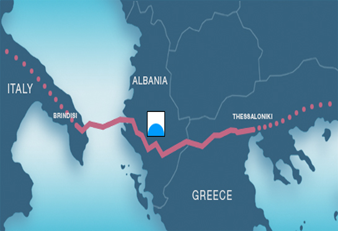
1.4 Russia Western and Blue Stream I-II
Russia has been the major gas supplier to Turkey since 1987. The volumes have increased gradually. In 2008, Turkey imported almost 23 bcm natural gas from Russian Federation. By now there are three separate contracts between Russia and Turkey and the gas is piped through two pipelines i.e. Western Line and the Blue Stream.
Western Line includes two contracts that were signed in 1986 and 1998. The combined plateau volumes of the two contracts fill the capacity of the pipeline. This line is an indirect line between Russia and Turkey crossing other countries’ territories such as Ukraine, Moldova, Romania and Bulgaria and is vulnerable to disruptions due the disagreements between third countries rather than between Russia and Turkey itself. In addition, in harsh winter conditions, the pressure of the gas volumes often decrease due to additional takeoffs by the transit countries and security of gas supply in Turkey is put at risk.
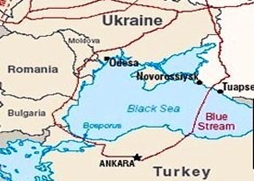
Blue Stream, on the other hand, is a direct gas pipeline between Turkey and Russia. It is a trans-Black Sea pipeline came into operation in 2003 and has a capacity of 16 bcm of gas annually.
1.5 Iran-Turkey Gas Pipeline
Gas deliveries from Iran to Turkey are based on the contract signed in August 1996 and the actual flow has started December 2001. The contract is a 25 year contract that will terminate in 2026 and 10 bcm of natural gas will be piped to Turkey at its plateau level.
The Turkish part of the pipeline is operated by Botas and this line meets with SCP in Erzurum. It is important to note that these lines are not transit gas pipelines but they supply gas to Turkish gas market and they are operated by Botas.
1.6 Iraq-Turkey Gas Pipeline
The negotiations of a gas pipeline between Iraq and Turkey dates back to 1996 bilateral proposal that envisaged to develop the annual capacity to pipe 10 bcm of gas from northern Iraq to Turkey. The political instability in Iraq and the American invasion in 2003, however, stalled the efforts to bring Iraqi gas to Turkish market. Given its proximity to Turkey geographically and the economic advantages of constructing a parallel gas line to the existing Kirkuk-Ceyhan oil pipeline, the prospects to export Iraqi gas to Europe via Turkey have gained momentum after some level stability is achieved in Iraq. In particular, a Memorandum of Understanding was signed between energy ministers of the two countries in August 2007 during Iraqi Prime Minister Maliki’s visit to Turkey. MOU included bringing Iraqi gas to Turkish market and further exporting it to European markets in addition to cooperation in oil and electricity areas. Iraq has also shown interest in contributing Nabucco project. Iraqi prime minister stated in Nabucco summit held in Turkey in July 2009 that Iraq would supply Europe with 15 billion cubic meters, or half of Nabucco's capacity (EurActiv, 14 July 2009).
1.7 Egypt-Syria-Turkey Gas Pipeline
The negotiations between Turkey and Egypt are also underway in order to bring the Egyptian gas to Turkey and further to Europe via Turkey. The half of the Syrian stage of the Arabian Natural Gas Pipeline which will bring Egyptian gas to Europe via Turkey has been completed and it is planned to connect the Syrian and the Turkish grids depending on the arrival of Egyptian gas to Turkey. This pipeline could obviously supply gas to the industrial and petrochemical markets of southern Turkey and potentially contribute to Nabucco pipeline that will supply gas to Europe.
1.8 Nabucco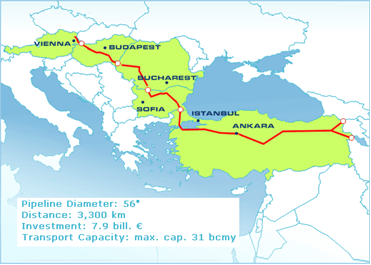
1.9 TANAP (Trans-Anatolian Natural Gas Pipeline)
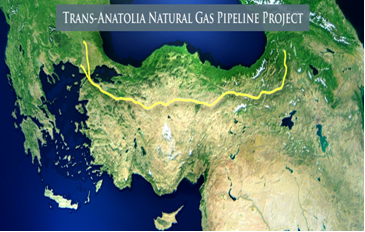
Project aims to transport Azeri gas from Shah Deniz II to Europe through Anatolia. Projected volume is 16 bcm per year of which 6 bcm will be reserved for Turkey’s domestic needs while the remainder 10 bcm will be shipped to Europe. The shareholders of the pipeline company are BOTAS (10%), TPAO (10%) and SOCAR (80%). The projected cost of the construction is 7 billion USD and the planned capacity is 16 bcm in 2020, 23 bcm in 2023 and 31 bcm in 2026.
The gas flow is expected to start in 2018.